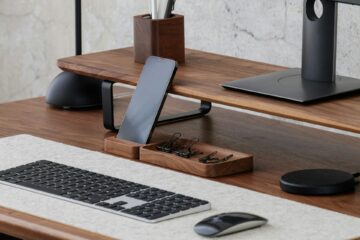
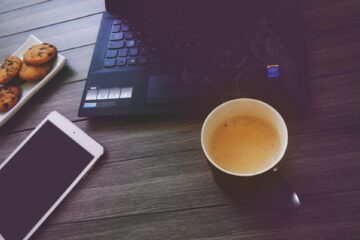
Some workdays feel scattered before they even begin. You sit down, the desk looks full, and your attention moves in too many directions at once. The idea behind the Quiet Structure Workflow is to create an environment that gently slows this scattering effect. Instead of pushing you into rigid systems, it frames the desk through soft cues, stable surfaces and subtle divisions that encourage calmer decisions.
It’s not a method that demands effort. It grows from the physical qualities of the workspace — how solid the base feels, how objects rest on it, how the layout influences the rhythm of your hands. When the desk begins to offer a structure that doesn’t shout for attention, the workflow adjusts on its own.
This approach works particularly well in spaces shaped by natural materials. Wood, metal, felt and cork tend to behave in predictable, grounded ways, giving the desk a quiet sense of stability. In practice, this steadiness becomes a foundation for clearer thinking, even when the day is filled with shifting responsibilities.
Quiet Structure Workflow – the calm created by steady surfaces
The Quiet Structure Workflow begins with something almost too simple to notice: a surface that does not move. When the main elements of the desk remain stable, your hands move with more certainty. A raised platform that doesn’t wobble, a mat that doesn’t slip, a stand that holds its place — all of these details reduce micro-adjustments that normally take up mental space.
Movement becomes smoother. You reach for tools with less hesitation. Nothing slides out of place when you shift your weight or change tasks. This grounded behaviour influences the nervous system more than expected. Even a few minutes into work, you feel less tense.
A steady structure also affects the visual atmosphere. When key objects hold their line, the desk looks calmer even if several items remain on the surface. Instead of competing for attention, they fall into a gentle order shaped by height, weight and texture.
Stability turns into a quiet orientation
Your mind follows what the desk communicates: slow, predictable movement instead of hurried correction.
Small boundaries that change the pace
Strict organisation can feel suffocating, but the Quiet Structure Workflow avoids that entirely. Instead of defined compartments, it introduces soft edges — visual boundaries that separate one working zone from another without closing anything off.
A raised edge of wood along the back creates a natural top line. A mat with clear borders centres the hands. A lower zone beneath a platform gives small objects a place to retreat when the surface becomes busy. These boundaries slow the speed of the desk just enough to make transitions smoother.
Because the boundaries are subtle, they never dictate how you must work. They act more like gentle suggestions, helping the desk settle into a layout that feels balanced without being staged.
The desk begins to pace itself
When boundaries are soft, the workflow becomes flexible but still grounded.
Quiet Structure Workflow – rhythm shaped by order, not control
This method isn’t about tidying. It’s about rhythm. A workspace that holds its structure naturally encourages a slower, steadier tempo. You move from typing to reading to writing with fewer abrupt shifts, because each part of the desk subtly points toward its own purpose.
A raised area invites visual tasks. A lower, open zone welcomes writing. A cushioned surface softens gestures. These relationships develop without deliberate planning. The desk forms a quiet map that the body follows almost unconsciously.
When you return to the workspace after a short break, the structure still holds. There’s no sense of starting from scratch. The rhythm restarts where you left it, helped by the physical cues that remain in place.
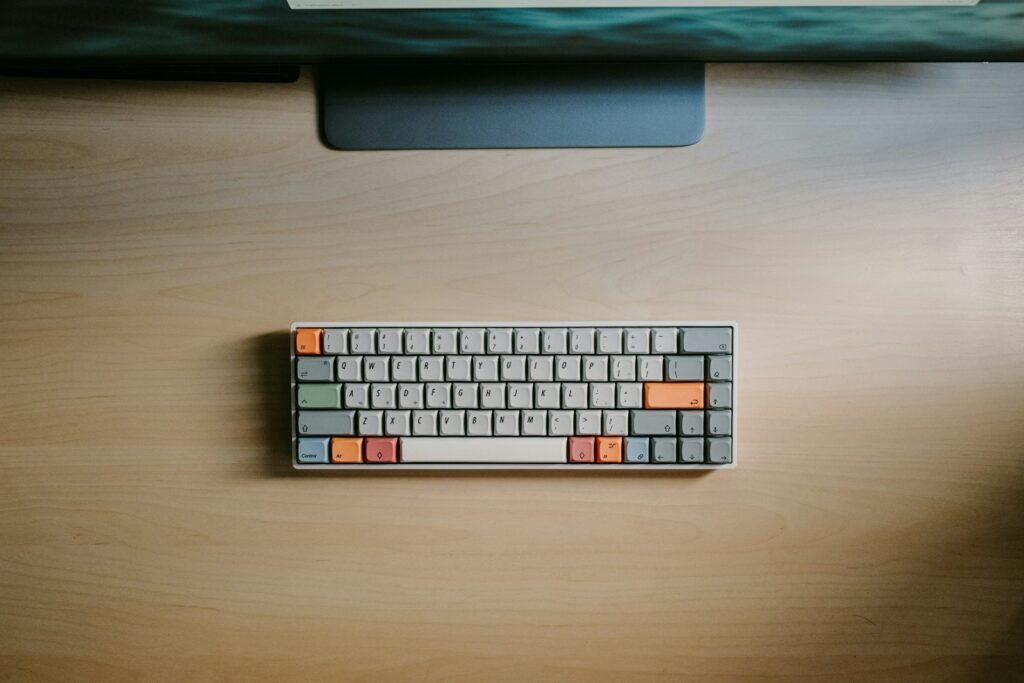
A gentle flow replaces constant reorientation
The workspace becomes a landscape rather than a set of disconnected tools.
Materials that support the method naturally
A structured workflow relies on materials that behave with consistency. This is why natural surfaces are such a fitting match for the approach. Solid wood carries weight and warmth without feeling heavy. Steel provides stability without shouting for attention. Felt softens sound while anchoring small objects. Cork offers grip without resistance.
Together, these textures influence how tools settle on the desk. They reduce jitter, mute harsh contact and create directional cues without needing labels or compartments.
The Quiet Structure Workflow grows from this material honesty. When the desk feels grounded, your movements become grounded too.
Texture sets the tone
You begin to work at the pace the materials encourage — calmer, more deliberate, clearer.
Quiet Structure Workflow – a layout that adapts to changing demands
One of the strengths of this method is that it is not fixed. It adapts as tasks shift. If a day requires more screen-heavy work, the eye settles naturally on the raised zone. When writing becomes the priority, the hands gravitate toward the open surface.
Because the structure emerges from stability and soft cues rather than strict lines, it flexes without collapsing. You don’t need to reset the desk to change modes. The desk simply absorbs the shift.
This adaptability is especially helpful in hybrid work settings, where routines vary between days. The structure remains steady even when expectations do not.
A desk that feels consistent even when the work does not
This constancy becomes its own source of focus.
A workspace that lets you breathe
A quiet structure is not the absence of movement — it’s movement that feels unforced. When the desk stops demanding corrections, the workflow becomes smoother and more humane. You spend less time managing the surface and more time using it.
Over the course of days and weeks, this ease accumulates. Fatigue builds more slowly. Transitions feel lighter. You end the day with more clarity because the desk assisted rather than resisted your work.
Nothing dramatic happens. The workspace simply becomes a place where tasks can unfold without friction.
Quiet structure creates quiet confidence
Your focus stretches further because the desk supports it instead of breaking it.